My blog has moved!

You should be automatically redirected in 5 seconds. If not, visit
http://jacquelinewhitmore.com
and update your bookmarks.

Showing posts with label jacqueline whitmore. Show all posts

Monday, October 06, 2008

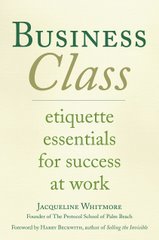
Jacqueline Whitmore's Book, "Business Class," Is Now Available in China


My book, "Business Class: Etiquette Essentials for Success at Work," is now available in China! If you are interested in purchasing a copy you can order it by going to:
http://tinyurl.com/47jwgb
.

Wednesday, August 06, 2008

10 Chinese Etiquette Tips to Observe at the 2008 Summer Olympics


The 2008 Summer Olympics are right around the corner. Beijing, China will be buzzing from August 8-24. If you are planning on attending the Olympics, it is wise to be prepared and enter China knowing the proper etiquette. I found a great article from MSNBC.com that gives some helpful tips about Chinese etiquette and how to respect their cultural differences.

1. Banquets: You don't have to eat everything (you can't possibly anyway, there will be too much food). But try a little of every dish by putting some on your plate or rice bowl. You don't have to eat it, but as foreign guest, you're supposed to be served first. If you don't try something, your host will be embarrassed—and most likely, will put it on your plate for you.

2. Bargaining: Open air markets, privately run stores are best for bargaining. (Large department stores have set prices.) Remember to establish a friendly rapport first. You are creating a relationship with the merchant, not a price war. Think of it this way: Bargaining is to the Chinese what seduction is to the French. Shouting, arguing, and pointing are not very seductive. Smiling, being friendly, offering to buy more for a better price are. And don't be afraid to ask, "Can you offer me a better price?"

3. Cars: Never, ever assume pedestrians have the right of way. Cars will not necessarily stop for you. Cross with a group if possible at a designated crosswalk. A car won't stop for a single person necessarily but will stop for a group because the driver doesn't want the car to be dented. Chinese really love their cars.

4. Chopsticks: Don't point with them at other people's faces. Don't stab your food with them like toothpicks. Don't lick them. And by all means don't stick them upright in your rice bowl—that's how the Chinese honor the dead at graves.

5. Face: Never shout even when someone has done something wrong. Losing your temper will only make the other person feel that he or she has lost face (i.e. dignity) and will often cause that person to refuse to take responsibility for a problem. Best to smile, keep friendly, and persistently ask the person to *help you* solve whatever problem has arisen.

6. Male-female relationships: Alas, the image of the loose American woman perpetuated by Hollywood movies is alive and well globally including in China. If a man makes unwanted advances to you, say loudly the Chinese word for "No," (bu) which is pronounced like the English word "Boo!" If you say it forcefully, it will be in the correct tone. If you are a man, don't be touchy-feely with Chinese women lest they think you are propositioning them.

7. Public displays of affection: While younger Chinese can be as openly demonstrative as Westerners, if not more so, older Chinese are not used to PDAs. Be aware of your surroundings. Around older Chinese anything more than holding hands with your partner or a quick peck on the check might embarrass people.

8. Respect for elders: It's fine to open doors and give up a seat to an older person of either gender. And don't be offended if younger Chinese—male or female—offer you an arm going up stairs or other assistance if you are older. They don't think you're infirm. They're just trying to be polite.

9. Smiling: Chinese smile for more reasons than Americans. A smile can mean the person is embarrassed, trying to be helpful, curious, happy or friendly. In the middle of an argument, smiling means that the speaker doesn't want this to become personal. When all else fails, smile in China. It shows you have no ill intentions and can work wonders in getting better service.

10. Tipping: If you plan to return to a restaurant, then tip. Guidebooks say not to, but in fact most Chinese know enough about the Western world to know that tipping is practiced regularly in other countries. Tips are rarely (in our experience, never) refused and create goodwill.

Source: http://www.msnbc.msn.com/id/23615910/
Authors: May-lee Chai and Winberg Chai

Tuesday, July 01, 2008

National Cellphone Courtesy Month


July is National Cellphone Courtesy Month – an event I founded in 2001 with the intent to encourage the increasingly unmindful corps of cellphone users to be more respectful of their surroundings by using some simple cellphone etiquette principles. In honor of National Cell Phone Courtesy Month, here are seven tips to those who want to improve their cell phone savvy:


1. Let your voicemail take your calls when you're in meetings, courtrooms, restaurants or other busy areas. If you must speak to the caller, use the e-mail or text messaging feature or excuse yourself and find a secluded area.

2. Speak in your regular conversational tone and don't display anger during a public call. Speaking loudly or showing emotion may distract those around you.

3. Use your vibrate function or turn off your phone in public places such as movie theaters, religious services, restaurants, etc. Many wireless phones now have environmental settings that automatically adjust the phone and its features so you do not disrupt your surroundings.

4. If you are expecting a call that can't be postponed, alert your companions ahead of time and excuse yourself when the call comes in; the people you are with should take precedence over calls you want to make or receive.

5. Avoid interrupting meetings, social gatherings or personal conversations by answering your wireless phone or checking your voicemail. Discreetly excuse yourself if you must take the call.

6. Use discretion when discussing private matters or certain business topics in front of others. You never know who is within hearing range.

7. When walking and talking on your wireless phone, be aware of your surroundings and remember to respect the rights of others.

For additional tips and more information about cell phone etiquette, go to Sprint's website at http://www2.sprint.com/mr/consumertopic.do?topicId=260.